DFW conducts research on the marine resources of the USVI independent of the commercial and recreational fishery. This includes environmental data such as water quality, as well as age and growth patterns of organisms with economical importance such as lobster and conch. This type of research and monitoring provides insight into the health and well-being of the USVI aquatic environment at a broader scale, informinglong-term management plans. DFW is currently conducting scientific research and monitoring on reef fish, conch, lobster, and water quality with the financial support of two grants: theSoutheast Area Monitoring and Assessment Program – Caribbean (SEAMAP – C) and theInterjurisdictional Fisheries Program (IJF) Both programs fall under NOAA Fisheries.
DFW
Southeast Area Monitoring and Assessment Program - Caribbean (SEAMAP-C)
SEAMAP – C is a five-year study with goals to better understand the reef fish population as the growth and recruitment of queen conch (Aliger gigas) and the Caribbean spiny lobster (Panulirus argus) in the U.S. Caribbean. DFW coordinates closely with project partners in the Department of Environment and Natural Resources in Puerto Rico to ensure consistency and continuity. A variety of methods are used for SEAMAP-C research surveys, and all sites are selected through stratified sampling based on benthic habitat and water depth. SEAMAP – C data informs management decisions made by both local and federal resource managers at the NOAA Southeast Science Fisheries Center’s Caribbean Branch.
REEF FISH
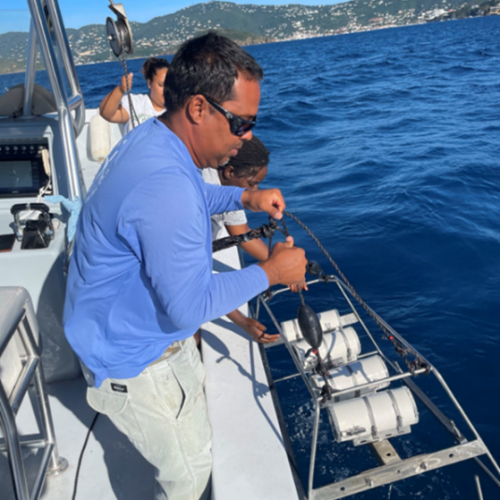
To assess various reef fish populations, DFW researchers conduct surveys that consist of both handline fishing and remote video. The videos are analyzed for fish diversity and abundance. The camera systems are also designed for researchers to calculate the length of the fish in the videos. Back in the DFW lab, all collected fish are processed for various measurements such as length, weight, sex, and reproductive stage. Otoliths are extracted from the inner ears of the fish to estimate the fish’s age by counting the otolith bands – just like tree rings!
DFW staff deploying the 4-camera stereo video array used for reef fish surveys on the DFW research vessel in St. Thomas. (Photo: Sennai Habtes, DFW)
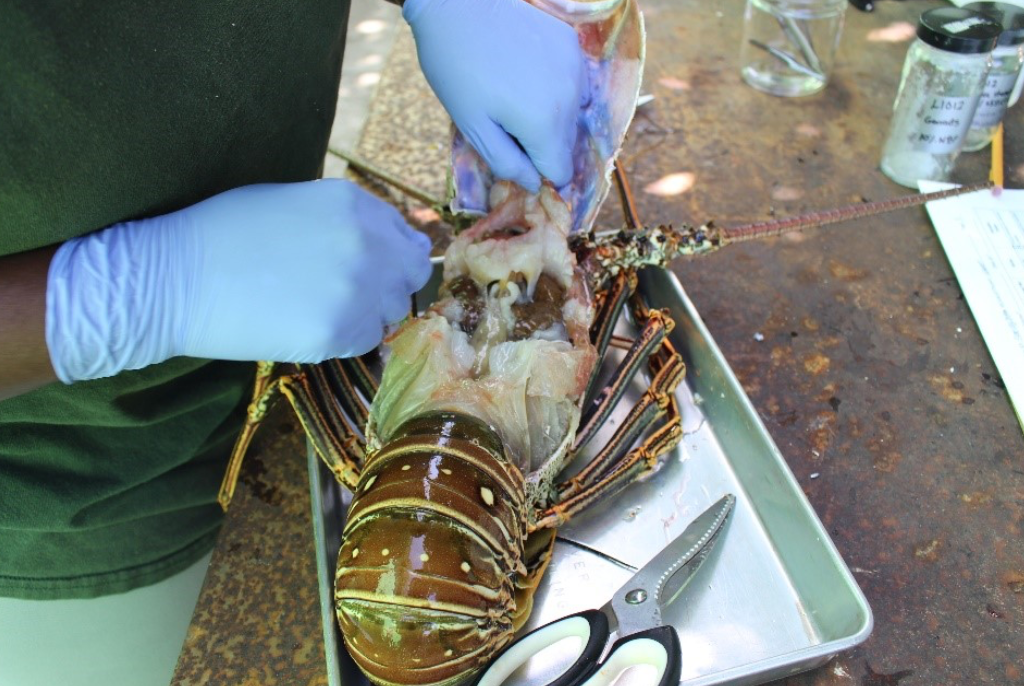
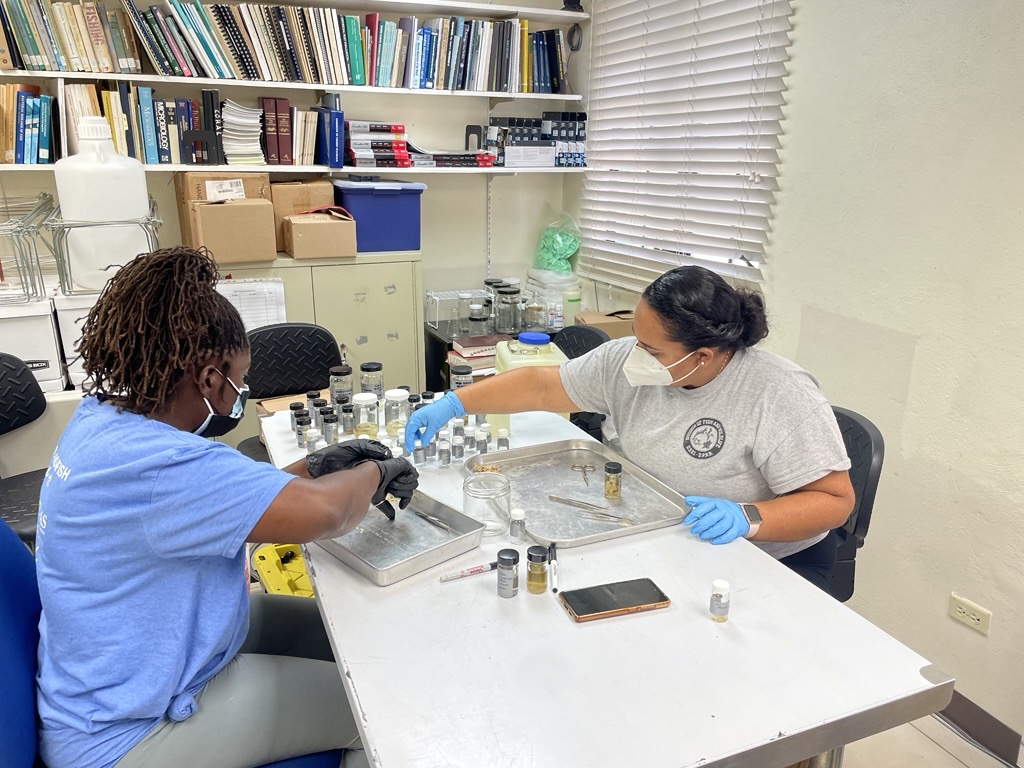
Dissection of a Caribbean spiny lobster to harvest the ossicles for age studies. (Photo: Julia Plotkin, DFW)
CARIBBEAN SPINY LOBSTER
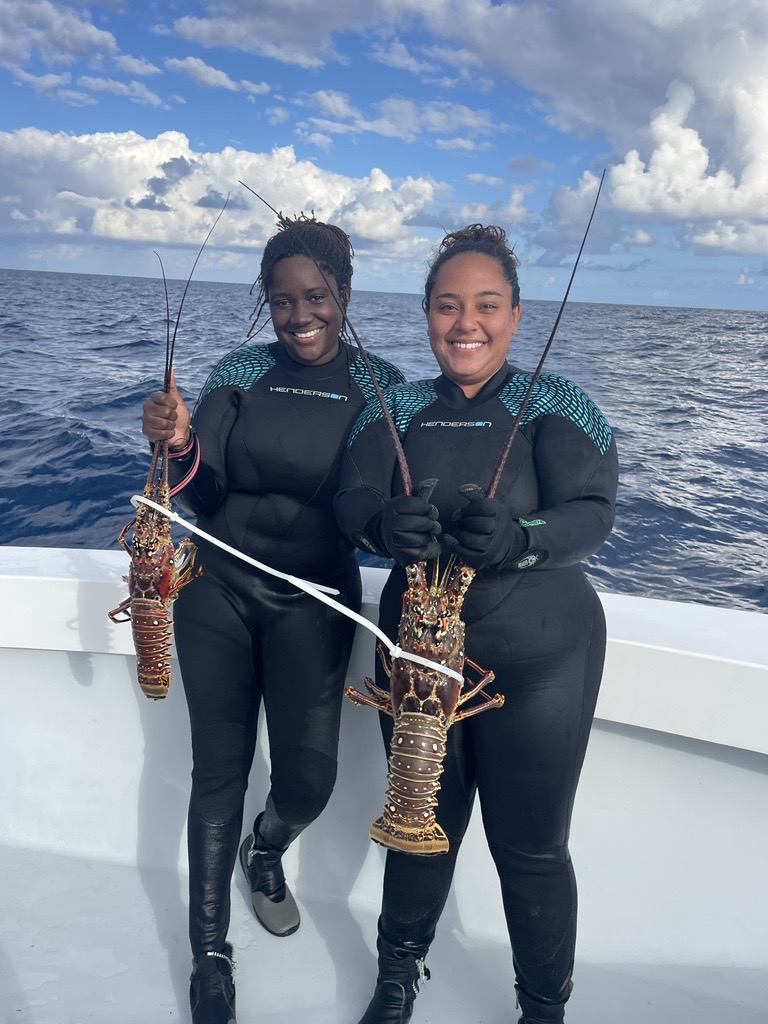
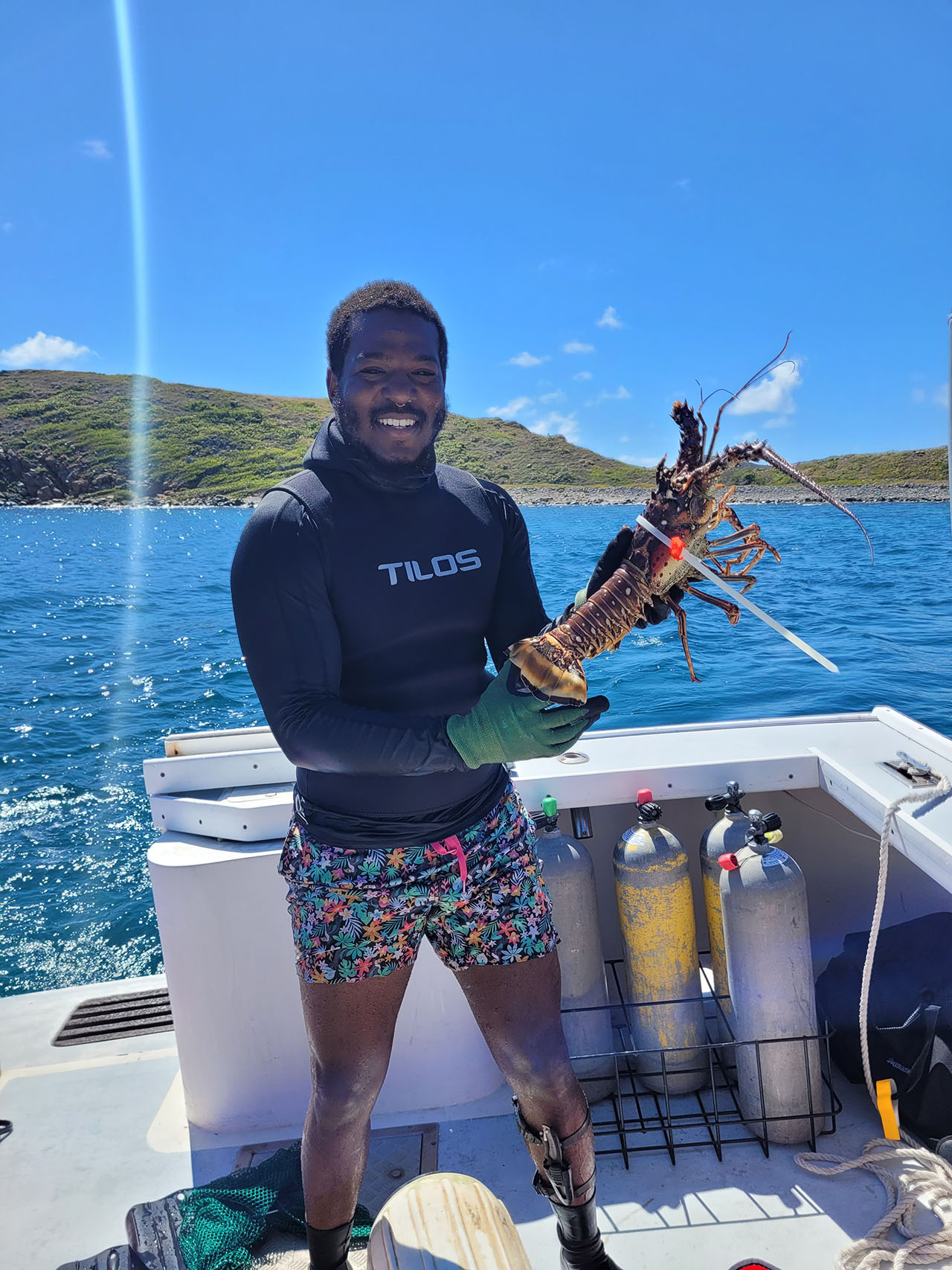
To understand the populations of Caribbean spiny lobster in the USVI, DFW researchers use SCUBA to conduct underwater visual census surveys in areas with suitable lobster habitat. The abundance of lobsters is estimated by divers and lobster samples are collected for further analysis in the lab. Lab processing involves dissection and extraction of the lobster’s ossicles which are found in their stomachs. Like otoliths in fish, ossicles are used to estimate the lobster’s age!
QUEEN CONCH
Queen Conch populations are assessed entirely using SCUBA to conduct underwater visual census surveys. Queen conch surveys occur along extensive 500-meter transects, so underwater scooters are used by DFW researchers to cover the distance on a single tank of air! 7-meter and 15-meter radial surveys are also conducted at randomized points along the transect. Abundance and growth measurements for individual conchs such as length and maturity are assessed by the divers.
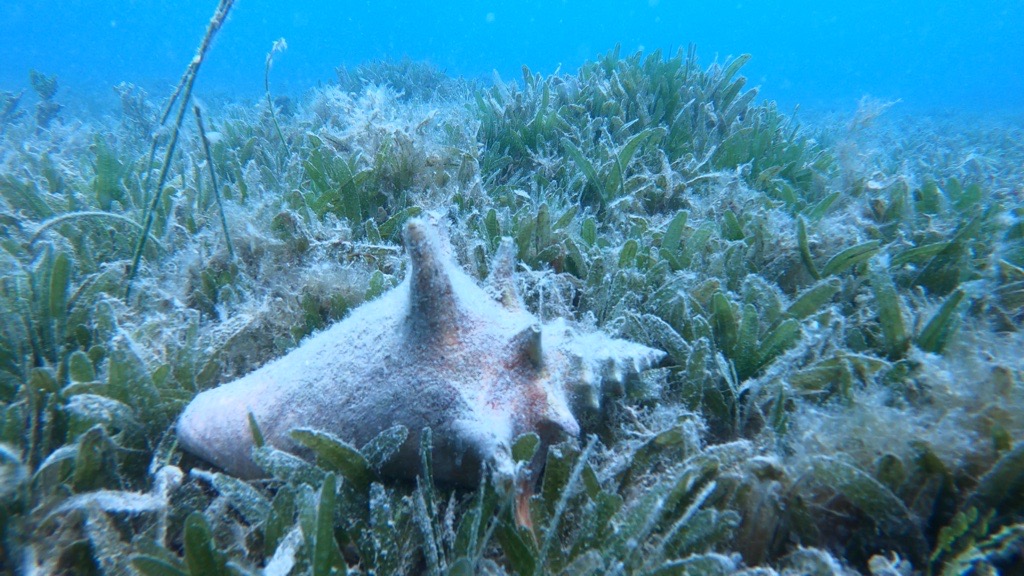
Queen conch observed during a dive survey. (Photo: Danielle Olive, DFW)
DFW
Shells
Pursuant to 12 V.I.C. § 105:
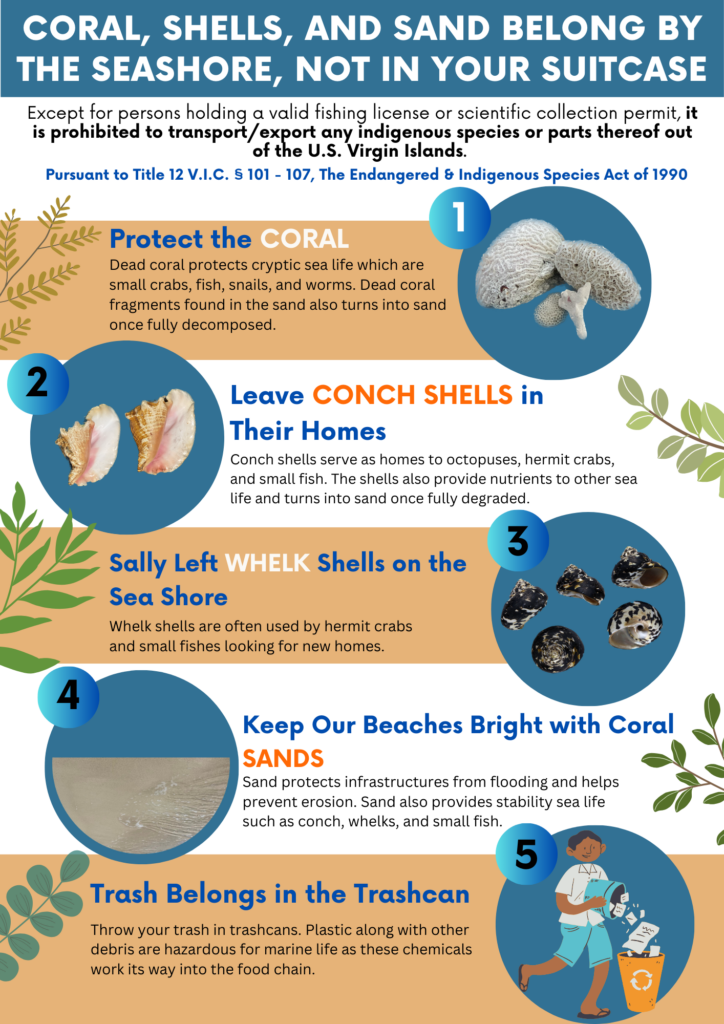
It is illegal for persons to transport or export any indigenous species or parts of that species out of the U.S. Virgin Islands without valid fishing licenses or scientific collection permits. This means that the removal of any shells, sand, coral, or parts of any marine organisms out of the territory of the USVI without the proper permits or licenses is expressly prohibited. Any person found in possession of specimens of this sort during travel out of the territory will be asked to relinquish them prior to travel and can face penalties depending on the amount and type of specimens being transported.
As a reminder, the export of any specimens or parts thereof of species listed as either threatened or endangered is expressly prohibited unless accompanied by appropriate permits or licenses by the Endangered Species Act (16 U.S.C. 1531-1544). The ESA implements the provisions of the Convention on International Trade in Endangered Species of Wild Flora and Fauna (CITES) which the United States is party to. This includes export of all parts from animals like marine mammals, sea turtles, coral, and now Queen Conch (https://www.federalregister.gov/documents/2024/02/14/2024-02966/endangered-and-threatened-wildlife-and-plants-listing-the-queen-conch-as-threatened-under-the).
DFW works closely with U.S. Customs and Border Protection and the Virgin Islands Port Authority to recover any corals, shells, sand, and other parts of marine organisms that are confiscated at ports in the territory. All of these materials are catalogued and returned to the marine environment so that they can continue to benefit the marine ecosystems of the USVI, particularly as habitat for younger or more cryptic species, and as substrate to benefit stability and resilience in the important marine ecosystems of that contribute to making the USVI so unique and beautiful.
The numbers below represent the number of pounds of marine life that has been confiscated by Customs and Border Patrol, in partnership with DFW From 2008-2016 and from 2020-present day. All confiscated marine life is returned to sea.
Pounds of Coral Confiscated
0
Pounds of Conch Confiscated
0
Pounds of Whelk Confiscated
0
Pounds of Shells Confiscated
0
Pounds of Sponges Confiscated
0
Pounds of Echinoderms* Confiscated
0
Pounds of Crustaceans** Confiscated
0
Pounds of Algae Confiscated
0
Pounds of Rock Confiscated
0
Pounds of Sand Confiscated
0
*Examples of Echinoderms are sea stars, sea urchins and sand dollars. **Examples of Crustaceans are hermit crabs and lobsters.
DFW
Aquaculture
Aquaculture can be an important means of diversifying the economy of the USVI, by increasing opportunities to establish Blue Economy opportunities, and improve food security issues in the territory. The USVI has had a strong focus on freshwater aquaculture production and mariculture (saltwater aquaculture) research in the past.
DFW is committed to developing, maintaining, and promoting the development of sustainable aquaculture in the USVI, such as expanding opportunities for mariculture research, production, and development to support expanded opportunities for local business and improved restoration of natural ecosystems. To support these efforts DFW has been working on the following projects:
Aquaculture & Mariculture Commission:
Under Act No. 6471, the VI Legislature created a Virgin Islands Aquaculture & Mariculture Commission. The director of DFW, Dr. Nicole Angeli, is a member of the commission and DFW staff along with commission members have worked to develop a comprehensive plan to guide the aquaculture and mariculture industry in the Virgin Islands.
You can read more about the Aquaculture & Mariculture Commission here.
Draft Rules and Regulations for Aquaculture Siting, Production, and Licensing:
One limitation to developing a robust and ecologically sustainable aquaculture sector for the USVI is the current framework for licensing and regulating aquaculture research and production in the territory. DFW is committed to developing clear and transparent regulatory framework that will enable a resilient, sustainable, and ecologically responsible aquaculture industry in the USVI. As part of this process DFW has developed Virgin Island’s Rules and Regulations that provides a framework for the preservation, management, and protection of farmed fishery resources, to regulate aquaculture and mariculture, and to secure their development in all marine, estuarine, and freshwaters within the jurisdiction of the US Virgin Islands. The rules and regulations are the framework for managing these resources under the authority granted in Tile 3 V.I.C., Chapter 22, Section 401(b)(16), Title 12 V.I.C., Chapter 1, Sections 1, 81c-d, and Title 12 V.I.C., Chapter 2, Section 105. DPNR developed these rules and regulations in 2023 an after a prolonged period where we evaluated and included public comments have drafted a final version which has been submitted for final approval.
Development of a Mobile Shellfish Hatchery Education and Training Facility:
In addition to developing rules that manage and sustain aquaculture in the territory DFW is developing resources to expand opportunities for research and extension in aquaculture. As part of this process, DFW secured funding through the Department of Interior’s Technical Assistance Program (TAP) and the US Fish and Wildlife’s Services Sportfish Restoration (SFR) program to develop a mobile oyster hatchery designed to be a research and teaching laboratory, for developing aquaculture production techniques for shellfish like Mangrove Oyster (Crassostrea rhizophorae) and native scallop species which are important species for habitat and water quality restoration in mangrove and seagrass ecosystems which are important for the health and resilience of juvenile sport fish populations. To develop this hatchery laboratory DFW has partnered with a Virginia-based oyster hatchery named Oyster Seed Holdings, which had received US Department of Agriculture NIFA SBA Phase I and II funding to successfully develop highly efficient mobile shellfish hatchery systems.
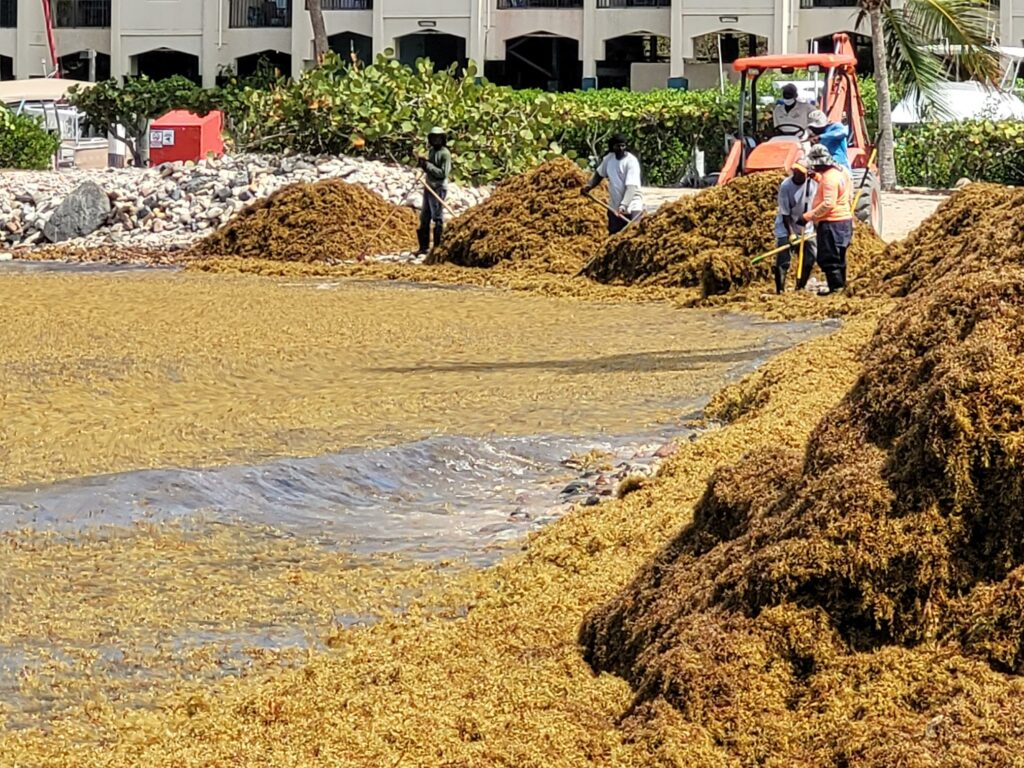
Like other communities in the southeastern US and the Caribbean the USVI has been increasingly impacted by coastal inundations of sargassum. Sargassum is a free-floating pelagic seaweed consisting of two species in the Caribbean (S. natans & fluitans). Sargassum occurred historically in the Sargasso Sea, reaching the shorelines of the USVI in small amounts by way of currents and tides. However, since 2011, the unprecedented scale of sargassum blooming in the Central Atlantic has resulted in increasingly frequent and more severe inundations of beaches and bays in the Territory, which has had negative impacts on the USVI Community, environment, fishery, and tourism industry. As such DPNR is taking several actions to improve our community’s ability to deal with this new natural disaster. To support businesses and community organizations in removal of sargassum from beaches the Division of Coastal Zone Management (CZM) has developed a new permitting process to allow for the mechanized removal of sargassum from specified shorelines. To support this DFW developed a guidance document for anyone conducting sargassum removal from the shoreline to be familiar with the plant (sargassum), it’s status as essential fish habitat and the threatened, endangered, and indigenous species of concern that may be residing, breeding, foraging in, or otherwise using sargassum, and best practices for responsible, ecologically sound, and lawful removal of sargassum.
DFW Collaborating on First Ever Funded NOAA NCCOS Monitoring and Event Response (MERHAB) Grant in the US Caribbean:
In addition to providing guidance on best practices for mitigation DFW is also trying to develop better systems to notify stakeholders and provide them with the necessary lead time to prepare and mitigate the impacts of sargassum inundations. To that end DFW has partnered with the University of South Florida (USF), Florida Atlantic University (FAU), NOAA Atlantic Oceanographic & Meterological Laboratory (AOML), and the Caribbean Coastal Ocean Observing System (CARICOOS) to develop an improved sargassum detection and forecasting system for the Southeastern US and US Caribbean. This project will develop an improved alert system that will give communities in Florida, Puerto Rico, the U.S. Virgin Islands, and the wider Caribbean more time to mobilize responses and minimize the harm caused by Sargassum inundation events (SIE’s). This project is led by principal investigator Dr. Brian Barnes at USF and will utilize increased resolution satellite data and state of the art regional ocean models to better predict the location and duration of SIE’s.
Because fish easily move across state, & federal boundaries Congress passed the Interjurisdictional Fisheries Act 16 U.S.C. 4101 et seq. (IFA) in 1986. The purpose of this program is to support state, territory, and interstate commission activities to conserve and manage interjurisdictional fishery resources. Through this initiative DFW is partnering with Puerto Rico’s Department of Natural and Environmental Resources (DNER), the Caribbean Fisheries Management Council (CFMC), and Puerto Rico Sea Grant to expand water quality monitoring and to increase capacity for the collection of data on reef fish and Caribbean Spiny Lobster age and growth. The purpose is to supplement fisheries independent sampling as part of the Southeast Area Monitoring and Assessment Program for the Caribbean (SEAMAP-C) conducted in the USVI. Through this project DFW is purchasing water quality sondes and laboratory equipment to allow the collection of a suite of water quality data including: Temperature, Salinity, Dissolved Oxygen, Chlorophyll, and Turbidity that will be collected during fisheries independent data collection. Water quality data is very important to the health and resilience of our fish stocks, particularly in areas important to juvenile fish. In addition, we will purchase the necessary equipment to measure fish and lobster aging and maturity. This effort will help the consistency of data collection and provide key environmental indicators to support ecosystem-based fisheries management and stock assessment for the US Caribbean.
 MENU
MENU